Web edition · 2026.10.20
Professor, I am still working on my topic — How many months have you been saying that?
Why can you not explain fifteen pages drafted with AI? A 62-slide lecture following fictional graduate student Minseo through topic refinement, paper reading, theory, hypotheses, methods, and advisor meetings.
An English translation of the web edition, retaining the presentation's claims, figures, quotations, and visual material while refining headings and flow. The original Korean presentation transcript is also available separately.
Read the complete lecture
If you have been saying I am still working on my topic for months, begin by asking how your question changed rather than how many pages you wrote. Follow fictional graduate student Minseo from being unable to explain an AI-produced draft to revising questions by reading an actual paper.
Prepared for week eight of graduate Communication Research Methods II at Hallym University Media School. Building on the previous survey-scale lesson, it connects concrete comparisons with concepts, theory, hypotheses, measurement, and research design.
Sixty lecture slides and two follow-up slides use eleven fictional illustrations, comparison tables, and step-by-step explanations so you can follow the argument from the slides alone. The last two slides introduce Socratic Advisor and an empty Obsidian vault for continuing your own study.
Includes the Korean slides and full reading version, with English introduction and reading. Observations, fictional examples, and actual research evidence are distinguished. The skill is not presented as completing a proposal for the student or automatically grading understanding.
Original research paper · Research on AI and critical thinking · Graduate advising guide
Professor, I am still working on my topic
How many months have you been saying that?
This class helps you find the next step between an AI-written draft and research you can explain yourself.
Changhyun Ahn · October 20, 2026
Minseo is a fictional master's student. Actual research and the instructor's experience are labelled separately.
Last week, you said two out of seven
You already use AI
- You summarize papers and draft text with GPT and Claude. About half of you also took a full methods course last semester.
- But ask how confident you are that you can write survey items yourself, and the answer changes. As I recall, more than 90% of roughly ten students said two on a seven-point scale.
We begin with that two
- Confidence of two does not establish that actual ability is also two. Last week, we distinguished liking, use, and confidence.
- Still, we cannot simply say, “Be confident,” and move on. We need to examine what you rely on when beginning research and where you get stuck.
Is a research topic a wild boar you catch with bare hands?
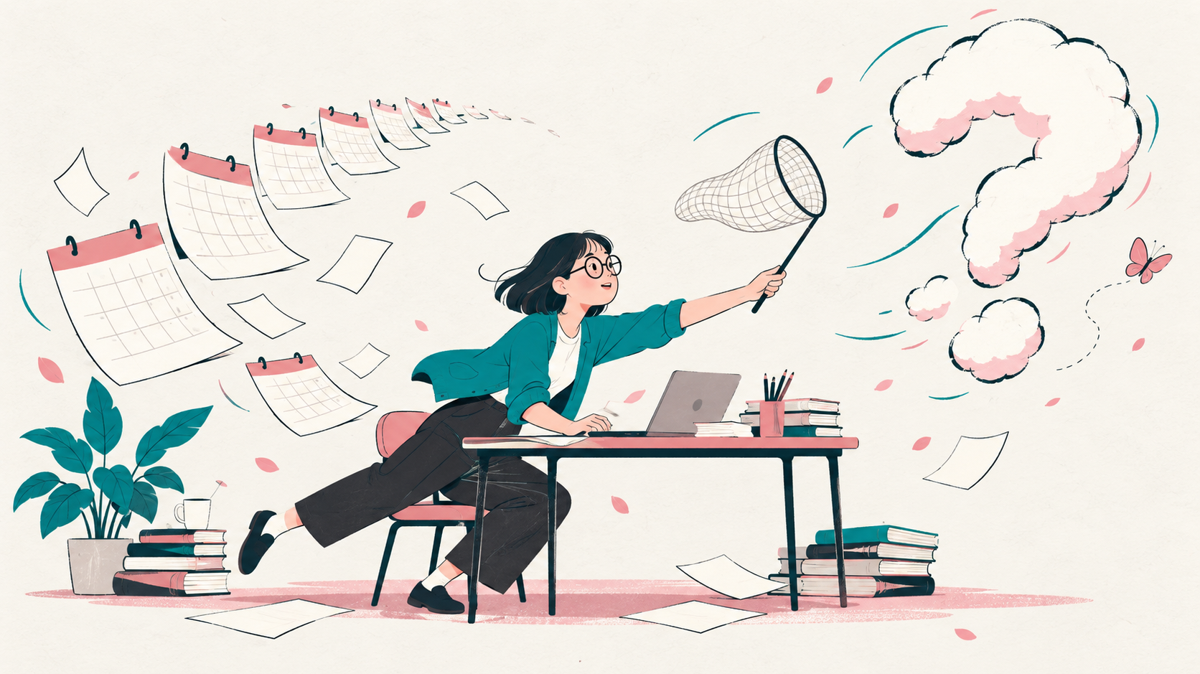
Fictional example · AI-generated illustration
You keep hunting for a topic without ever seeing it
- The first time you say, “I am still finding a topic,” that can make sense. You may be exploring an area or changing your mind as you read.
- If you say the same thing a month later or next semester, it is a different story. You are in your second or third master's semester and still finding it.
- I know you searched for materials and asked AI. But ask what you learned since last time, and you say, “Once I organize it a little more…”
When does “a little more preparation” end?
Why the student postpones
- “I feel bad visiting empty-handed. I want to read a few more papers and organize my thoughts before I speak to you.”
- But you cannot decide alone how many papers are enough, what needs organizing, or whether you are ready.
- A month later, and next semester, you say the same thing. If you keep preparing because you cannot judge this alone, will spending more time in the same place solve it?
What an instructor can examine with you
- “I searched with these terms, but I do not know whether this is my field. I read this paragraph, but I cannot explain it from here onward.”
- You do not need a finished title. If we can see what you did and where you got stuck, we can decide the next step together.
- Today, we are improving the sentence you use to ask for help before polishing an impressive title. Showing what you do not know gives us material for deciding what to do next.
Move from the sticking point to the next task
01
State your interest
Do not start by generating a paper title. Describe in your own words what you saw and what it made you wonder.
02
Check the original
Find the part of an actual paper that overlaps with your question. Record only what you have read.
03
Revise your sentence
Before adding theory, hypotheses, or methods, check what you mean when you use the same word.
04
Bring a question
Show what remains undecided in a form your instructor can help assess. Decide what to read next after the meeting.
Follow Minseo, a fictional master's student
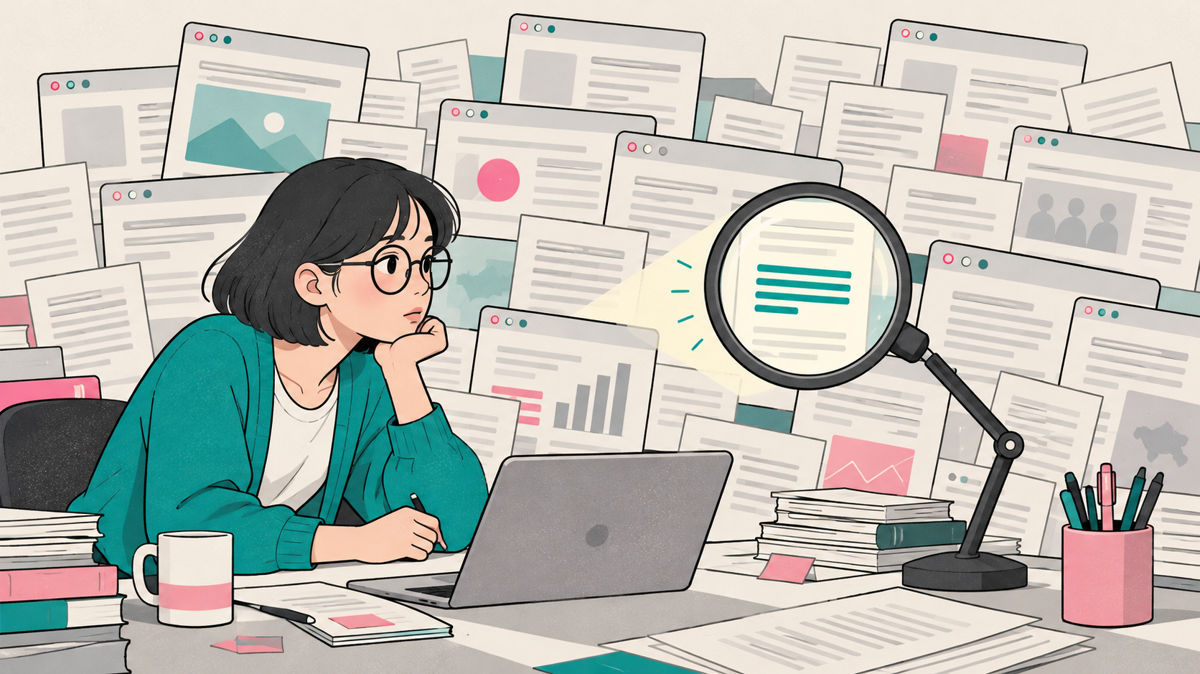
Fictional example · AI-generated illustration
Plenty of interests; stuck turning them into research
- Minseo is interested in AI and media. Deepfakes seem problematic, fake news seems problematic, and people's trust in AI content is interesting too.
- Minseo knows it is time to visit the professor. But without confidence about answering “What do you want to do?”, Minseo searches for more papers first.
- Every title looks relevant, yet some abstracts seem unrelated. Unfamiliar theories and methods send Minseo from tab to tab.
The file gets longer; confidence gets lower
01
Afraid of arriving empty-handed
It feels as though there must be something to show the professor. Without knowing how many papers are enough, Minseo starts searching.
02
The tabs multiply
Both theory and methods are unfamiliar. Reading one paper leads to opening another; soon there are twenty tabs.
03
AI fills the gaps
“Suggest a topic.” Trust, literacy, and moderation effects line up. There are titles and hypotheses now; it feels like progress.
04
Judgment is still required
Minseo still does not know what is feasible or what to cut. Without confidence about explaining the draft, Minseo asks AI to write more.
I understand why Minseo keeps using AI
The deadline will not wait
- “Read enough and think carefully” can be maddening when you do not even know when “enough” ends.
- You told your professor that work was underway, and you must show something. Making the file longer looks like a solution you can actually grasp.
So we make the next decision smaller
- We will not stop at telling you not to use AI. We will separate what to ask, where to check for yourself, and which question to bring.
- Instructors must also go beyond “Think about it some more.” They need to help students recognize the next action.
I am going to Seoul. Where in Seoul?

Fictional example · AI-generated illustration
“AI and fake news” is still a broad address
- “I want to study AI and fake news.” You have named a neighborhood of interest. What you will actually do is still unclear.
- It is like asking which subway line to take because you are going to Seoul. The route depends on whether you are going to work or to a concert.
- Simply saying “Make your research question specific” is still hard. Let me ask first: which particular situation caught your attention?
A concrete situation comes before academic terminology
What Minseo actually wants to know
- ‘I think people might trust the same news less if they are told AI wrote it.’
- There is the same news story, a label saying AI wrote it, and an expectation that people will judge it differently. Now we can see what you want to compare.
Do not make it difficult already
- If the sentence becomes “The cognitive characteristics of recipients of generative-AI-based information…”, Minseo loses their own words again.
- Start by refining “Will people believe it less if they are told AI wrote it?” Add terminology to explain the situation, not to obscure it.
Written by AI does not mean false
| What to distinguish | A possible situation | How it changes the search |
|---|---|---|
| Actual authorship | AI can write accurate content, and content written by a person can be wrong. | Do not treat AI authorship and factual truth as the same thing. |
| Authorship label | Even with identical content, seeing a label that says AI wrote it may change a person's judgment. | Minseo's question is closer to how people interpret that label. |
| Terms to search | Try terms for AI authorship labels and accuracy judgments, including “AI-generated label” and “news accuracy.” | You may find different research than a search for “fake news” alone would produce. |
Start by asking AI to turn your words into search terms
A request for AI
- “I wonder whether people believe the same news less when it is labelled as written by AI. Suggest Korean and English search terms for relevant research.”
- “Distinguish content actually written by AI from content labelled as AI-written. Do not invent paper titles; first give me search terms.”
What I do next
- Open the search results yourself. Check that the recommended title and authors exist and that the link leads to that paper.
- If you could not find the original, record that. Do not list a paper you could not find as something you have read.
You can ask before reading ten papers
What you can show now
- “I am interested in how AI authorship labels affect judgments of news. I searched with these terms, but I do not know whether this is the field I should enter.”
- Even before you read ten papers, this shows what you want to do and where you need help.
An unsuccessful search is also material
- You can distinguish overly broad search terms, a need for another field's vocabulary, and finding a paper but being unable to access its full text.
- While you wait because you feel unprepared, the terms you searched and the screen where you got stuck are already things you can ask about.
“Professor, they have already done everything I wanted to do!”
We found an actual paper
- Altay and Gilardi's 2024 paper examines judgments of news headlines labelled as AI-written. It reports two online experiments in the United States and the United Kingdom.
- The title looks similar to Minseo's idea. That means the search worked. It is not a verdict that your idea is worthless.
Do not jump to either conclusion yet
- “They already did it, so I will drop it.” You are abandoning the entire interest before reading what overlaps and how far.
- “Then I can use Korean college students instead.” You are declaring novelty before checking why changing the population would matter.
Altay & Gilardi (2024) · doi:10.1093/pnasnexus/pgae403
The same six-point range can ask different things
At first, you said “believe less.” Reading the original methods section reveals different questions inside that phrase.
| What to examine | Accuracy judgment | Sharing intention |
|---|---|---|
| What is being asked? | Participants rate how accurate the claim in a news headline is. | Participants rate how likely they are to share that news headline. |
| Response scale | 1–6: from “definitely false” to “definitely true.” | 1–6: from “extremely unlikely” to “extremely likely.” |
| Assignment in Study 1 | Half of the participants rated accuracy. | The other half rated sharing intentions. |
Altay & Gilardi (2024) · doi:10.1093/pnasnexus/pgae403
Do you share everything you consider accurate?
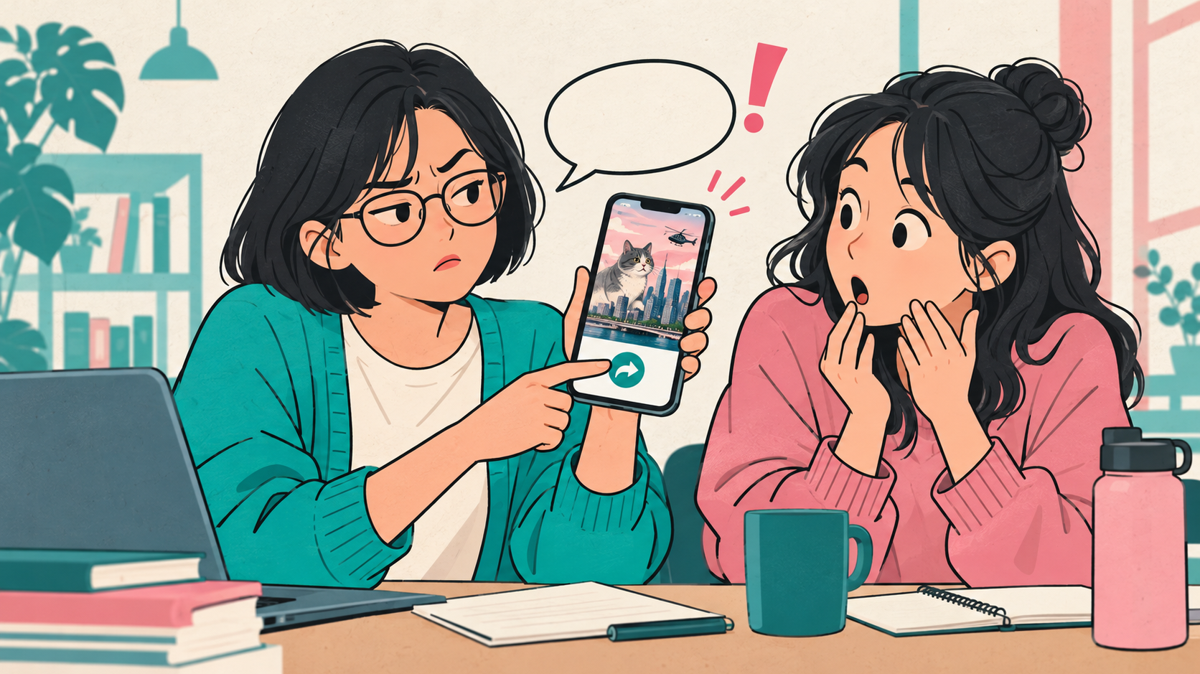
Fictional example · AI-generated illustration
Separate the judgments hidden inside “believe”
- An exchange-rate story may seem accurate without being something you want to post in a group chat. Accuracy judgments can be high while sharing intentions are low.
- Conversely, someone might share an absurd post saying, “Look at what is going around.” Interpreting sharing alone as belief creates confusion.
- This is like distinguishing liking, frequency of use, and confidence last week. Survey items are not parts suddenly attached in the methods chapter; they help establish what you mean right now.
Altay & Gilardi (2024) · doi:10.1093/pnasnexus/pgae403
Reading changed my question
Before reading
- “I think people will believe it less if they are told AI wrote it.”
- What they believe, and which response would count as belief, remained broad. Sharing behavior and an accuracy judgment could also get mixed together.
After reading the methods
- ‘I wonder whether an AI authorship label affects judgments of a news headline's accuracy.’
- The final topic is not settled. Still, what you want to investigate is clearer. Even without understanding the entire paper, you have a reason to revise your sentence.
Altay & Gilardi (2024) · doi:10.1093/pnasnexus/pgae403
But you understand it immediately
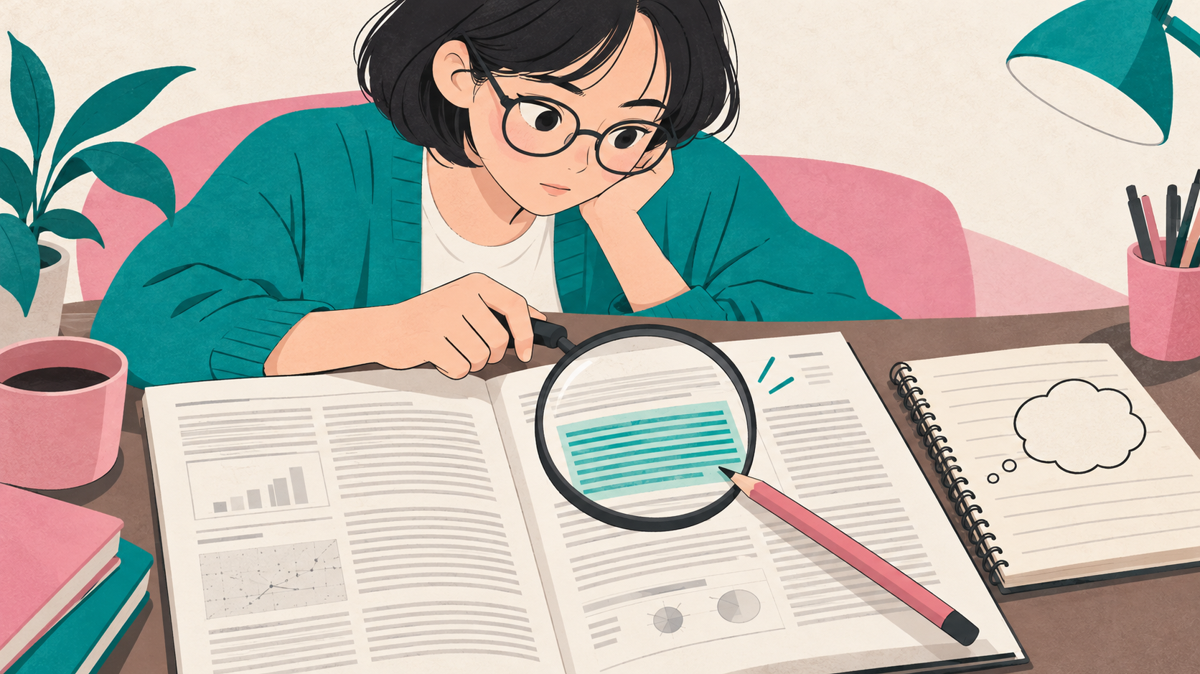
Fictional example · AI-generated illustration
You do not need to understand everything before asking
- Yes, instructors have background knowledge and can find relevant passages and problems faster. Saying “Just read” cannot erase that gap.
- Today, focus on one question: “What did participants see, and what did they answer?” You can ask AI to locate the relevant section and a short phrase to search for in the original.
- Even after receiving an easy Korean explanation, open the original. Check that the actual question and scale are there and that AI has not added something absent.
When you open the source, is that statement there?
01
Find the location
“Identify the section describing what participants actually saw and the questions they answered. Do not guess about material you cannot find in the PDF.”
02
Open it yourself
If the page is wrong, search again using the section heading or a short phrase. A citation marker alone is not the end of the check.
03
Compare the explanation
Compare the original questions and scales with the AI explanation. Ask again about the exact sentence you do not understand.
04
Record the boundary
If you checked that paragraph today, record that you read that far. Do not present the rest as though you understood it too.
Read the relevant parts to the necessary depth
| The current task | Where to check first | Why further reading is needed |
|---|---|---|
| Understand the question | Find what participants were shown and asked in the methods section. | Check whether your word and the researcher's measure refer to the same thing. |
| Evidence for a hypothesis | Find explanations relevant to your expectation, and check the results and limitations too. | Do not read one explanatory sentence and then write as though the actual findings necessarily matched it. |
| Referencing methods | Examine the sample, conditions, items, and analysis more closely. | You must judge whether the method can also be used with your data and circumstances. |
Before waiting for AI’s eleventh explanation
If you keep getting stuck in the same place
- AI has explained it ten times. You nodded then, but when asked to explain it alone, you get stuck again.
- You do not need to hide the entire table or wait until you understand the whole paper.
Bring the location you do not understand
- “I cannot tell which comparison in this table is the one I am interested in.” Bring the original location, and an instructor can examine it with you.
- Starting with relevant parts does not mean never reading the rest. It means first forming a question that helps with the decision in front of you.
AI says my new idea is novel
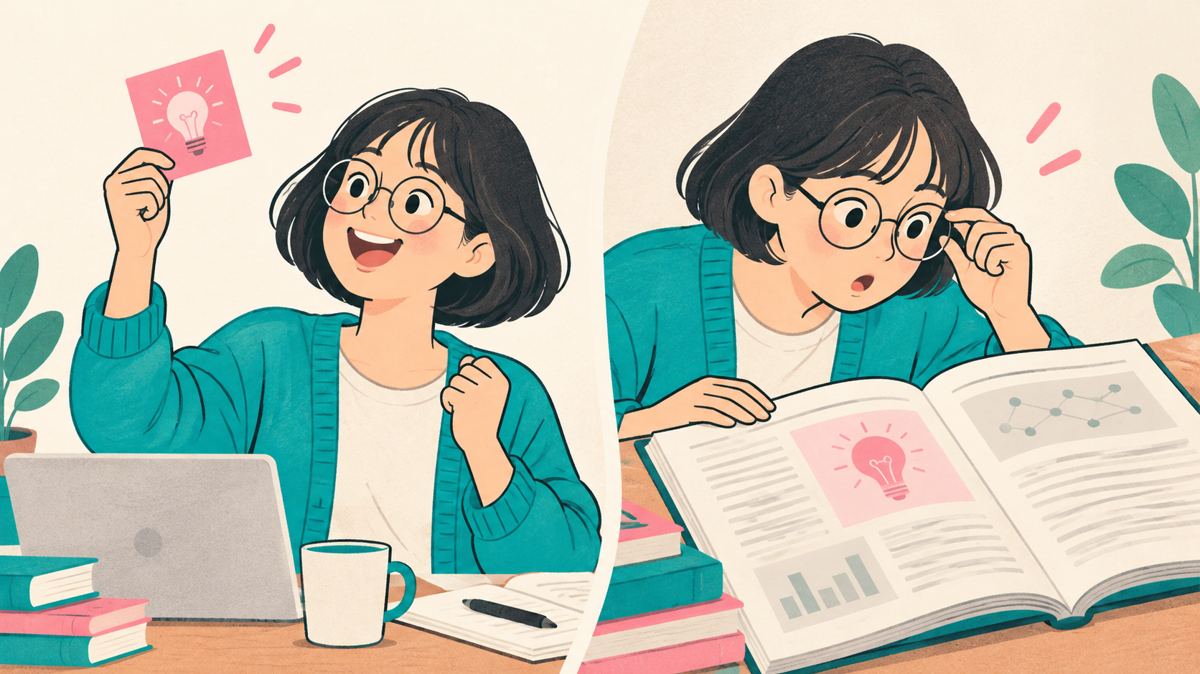
Fictional example · AI-generated illustration
This time it really felt like my idea
- Minseo wonders, “Instead of only adding an AI-written label, what if we also explain how much a human was involved?”
- The idea is to distinguish an explanation that a journalist wrote the story and AI only polished it from one that AI chose the topic and wrote the entire article.
- “It is highly original,” says AI, and that feels good. But the praise does not tell you which research was searched or how thoroughly.
Altay & Gilardi (2024) · doi:10.1093/pnasnexus/pgae403
Read Study 2 before claiming a distinctive contribution
| What to check | The initial idea | What the original shows |
|---|---|---|
| Idea | “Would explaining how much a person was involved make this new?” | Study 2 explained the meaning of an AI-written label using different levels of AI involvement. |
| Conditions | I wanted to distinguish polishing sentences from writing the entire article. | The original describes explanations such as polishing sentences, drafting from supplied material, and choosing the topic and writing the entire article. |
| Current judgment | I wanted to present this distinction immediately as my study's novelty. | What varied was the explanation of the label's meaning, not the actual production process. We must first check what has already been addressed. |
Altay & Gilardi (2024) · doi:10.1093/pnasnexus/pgae403
Today was not a failure to find a topic
If you stop at “It has already been done”
- “I guess I have no ideas.” That conclusion sends you back to asking for new titles from scratch.
- One abstract does not cover all prior research, and an overlap with one paper does not close off your entire interest.
Turn it into a question for the next meeting
- “Study 2 explained AI labels by distinguishing roles. I am unsure whether to keep reading in this direction or first examine how accuracy judgments differ from other responses.”
- “I checked that the distinction I initially thought was novel overlaps with prior research.” Record that, and next week you need not celebrate the same idea as new again.
Altay & Gilardi (2024) · doi:10.1093/pnasnexus/pgae403
Another pile of summaries in Obsidian?

Fictional example · AI-generated illustration
Leave sentences your future self can recognize
- Paste an entire AI summary, and next week your first question may be, “Why did I save this?” Concepts you worked hard to separate today may become mixed again.
- You do not need a new plugin or a pretty graph. Write down your current question under a title such as “Why might people believe news less when they see an AI label?”
- Link an existing paper note, or begin with the link and location if that is unfamiliar. It would be a problem to spend another day organizing the organization system instead of reading.
A record Minseo left after reading
| What to record | Minseo's fictional reading record |
|---|---|
| What I initially wondered | I wondered whether people trust identical news less when it is labeled as AI-written. |
| What I checked directly | Study 1 asked separately about accuracy judgments and sharing intentions. My word “believe” was too broad. I checked Design and procedure on PDF page 3. |
| Where my thinking changed | I thought distinguishing the roles described by an AI label would be new, but Study 2 had a similar distinction. I cannot simply claim this as my study's novelty. |
Fictional student record / Altay & Gilardi (2024), methods of Studies 1 and 2
What you do not know also helps determine the next task
| What to record | Minseo's fictional reading record |
|---|---|
| What I still do not know | I have not checked research published after this paper. I also find it difficult to judge which responses besides accuracy judgments would be worth examining. |
| What to ask my professor | I want to ask whether I should keep reading from this starting point. If so, I want to know which differences to look for in the next paper. |
| What AI told me | I can keep it, but label it “AI-suggested explanation, not yet checked.” I do not mix it with knowledge I checked in the original. |
This form is not a ticket to the meeting
If you wait to fill every blank
- You say you will prepare more before visiting because you cannot fill in “What I checked directly.” A beautiful note can repeat the same problem.
- If you have not found the paper or understood the paragraph, AI filling the blank plausibly makes the boundary of your own knowledge unclear again.
Record your current state as it is
- If you could not find it, record the search terms and where you got stuck. If you read it but cannot explain it, record the location and your question.
- This is a record of your current judgment, not a finished note. Do not wait another month because of blank spaces.
Does inserting a theory name create a theoretical background?
Fictional example · AI-generated illustration
Set aside the names and years for a moment
- “A paper needs a theoretical background.” Ask AI to add related theories and make the writing academic, and names will appear.
- But “Why is this theory needed here?” stops you again. First, explain in ordinary language why an AI label might change accuracy judgments.
- Minseo says, “People may think someone posted it without reading it because AI wrote it.” Now we can begin to see what explanation to investigate.
Look for the reason between a label and a judgment
01
See the label
The news has a label saying AI wrote it. This is the situation that first interested Minseo.
02
Infer whether it was reviewed
Minseo expects that people might think, “A person probably did not read this properly.”
03
Judge accuracy
The question is whether that inference would lead to lower accuracy judgments. We do not yet know whether everyone actually follows this path.
04
Find relevant studies
Look for research that supports or challenges this explanation. Do not pull in sentences merely to protect your initial conclusion.
Minseo's fictional explanatory path · Not a validated causal model
Find your explanation before naming a theory
How to ask AI
- “My expectation is that seeing an AI-written label could make people infer there was no human review. Suggest relevant research concepts and search terms.”
- “Do not treat distinct concepts as equivalent. Separate what can be checked in the attached paper from what requires further searching.”
What I need to check
- Read original sources for the concepts AI introduces. Check what phenomenon each concept explains and why it is needed for this question.
- Reading may suggest that what people think AI did matters more than simply disliking AI. If so, your explanation and hypothesis must change too.
The same lunchbox, different inspection labels?
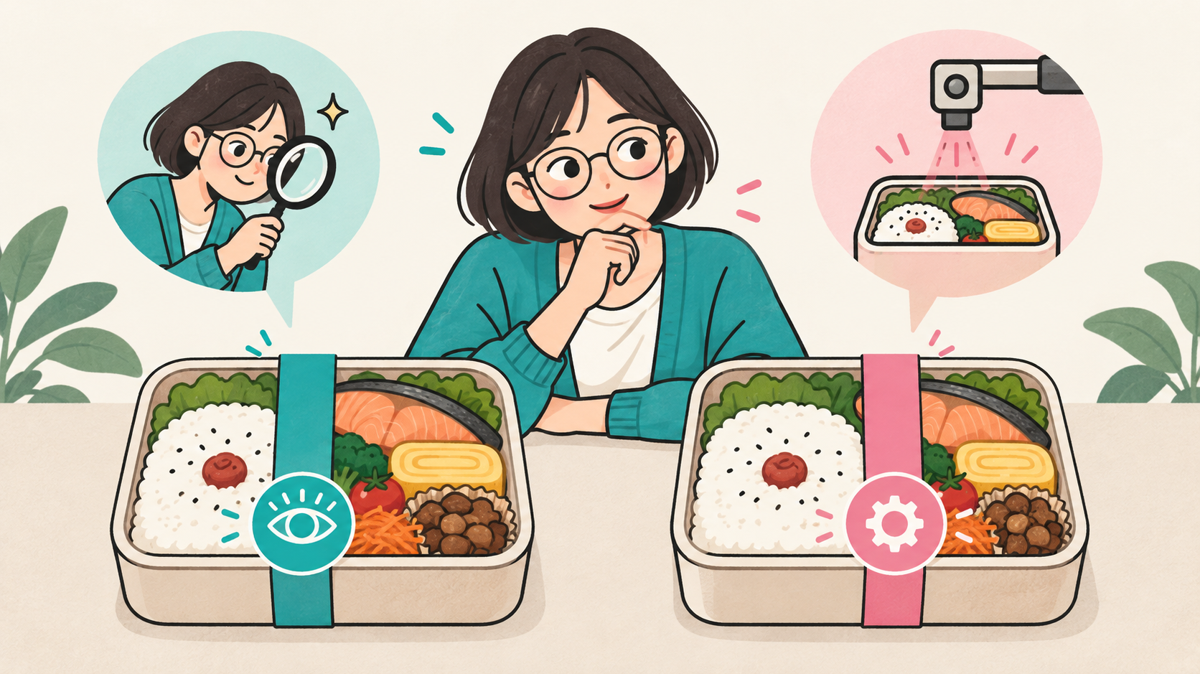
Fictional example · AI-generated illustration
An analogy helps understanding; research evidence needs a separate check
- Suppose one label says, “A person performed a final check after cooking,” and the other says, “Processed automatically.”
- Before inspecting the food itself, you may infer who checked it and how. This analogy helps explain how a thought could come between a label and an evaluation.
- But the lunchbox story cannot be cited as evidence about news. You must read actual research that can support “I expect this to happen for this reason.”
I asked for a hypothesis and got eight arrows
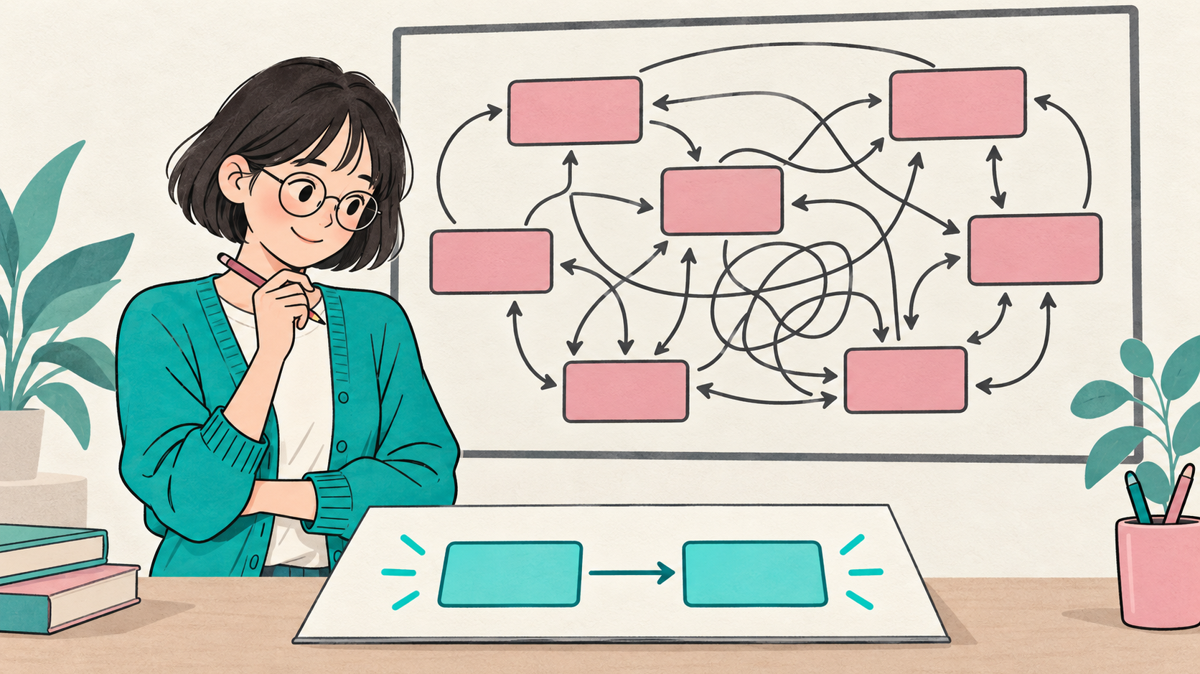
Fictional example · AI-generated illustration
If it looks like a paper, is it my research?
- Fictional AI sentence: “Generative AI literacy will affect news acceptance intention through algorithmic trust, moderated by need for cognition and technology anxiety.”
- Does literacy mean frequent use, knowing how it works, or being able to evaluate results? Does acceptance mean reading, believing, or sharing?
- Even if you understand an easy explanation, why your study needs each variable remains unresolved. Begin with one arrow you can explain all the way through.
Explain one arrow all the way through
“For the same news headline, accuracy ratings will be lower with an AI-written label than without one.”
| What to ask | Answers in the practice hypothesis |
|---|---|
| What is compared? | Compare the same news headline with and without an AI-written label. The label condition being compared is called the independent variable. |
| What is expected to differ? | Accuracy ratings of the news headline are expected to be lower with the label. Accuracy ratings, examined as the outcome, are the dependent variable. |
| Why expect that? | Check the paper you read and its explanation. This example overlaps with existing research and should not be submitted as Minseo's novel hypothesis. |
Two AI questions are not necessarily the same hypothesis
| What to compare | Presence of a label | A person's attitude toward AI |
|---|---|---|
| The difference on the input side | Show the label to some people and not to others. | Ask how positive each person's attitude toward AI is. |
| The relationship to examine | Examine whether accuracy ratings differ across label conditions. | Examine whether AI attitude scores and accuracy ratings vary together. |
| The situation to sketch first | Sketch what you would show differently and which responses you would compare. | Sketch what you would ask people and which scores you would compare. |
You expect a higher score, but cannot say why?
If only the sentence ending becomes more confident
- Changing every sentence to “The higher X, the higher Y” does not make it science. You still need to explain why you expect that direction.
- Memorizing “independent variable” and “dependent variable” will not resolve the design if you cannot picture the comparison.
If the direction is still hard to specify
- You may keep “What differences are there?” as a research question and discuss it with your advisor. Not all research requires the same form of causal hypothesis.
- First describe what you would show, ask, and compare. There is time to add the necessary terminology afterward.
“More use means less confidence”?
What I observed in class
- I saw you using AI, and you reported low confidence about creating a survey. That much is the instructor's experience.
- But we do not currently have paired data identifying how much each student used AI and which confidence score that same student gave.
What we cannot claim without data
- “More AI use means less confidence” claims that two values vary together. An observational impression alone is not enough to say that.
- First check whether use and confidence were measured together. Before separating correlation from causation, establish whether the relationship itself was examined.
Even with a relationship, causation remains unresolved
Suppose this time we have fictional data
- We collected each student's AI use and confidence. Students with higher use reported lower confidence.
- Now we have data for examining a relationship. We still cannot jump straight to “AI reduced their confidence.”
The same data allow other explanations
- Low confidence may have led to more AI use. A difficult assignment may have increased AI use and reduced confidence.
- To distinguish explanations, examine what happened first, the comparison group, and conditions that changed together. Adding “effect” to every hypothesis skips this work.
Should we confiscate coffee when people are tired?
In a fictional survey, people who drank more coffee reported greater tiredness. Those responses alone cannot settle which of the following stories is correct.
| Possible explanation | A story consistent with the same observation | What else to check |
|---|---|---|
| Coffee → tiredness | Coffee may have disrupted sleep and increased tiredness. | Check which came first: coffee or tiredness. |
| Tiredness → coffee | People who were already tired may have sought more coffee to keep going. | Examine tiredness before drinking and the reason for seeking coffee. |
| Deadline → both | A deadline may have caused both less sleep and more coffee consumption. | Check whether another condition could change both responses. |
If both the news and the label differ, which caused the difference?
| What to examine | A confusing comparison | A comparison designed to separate the difference |
|---|---|---|
| The news shown | Group A sees one story and group B another. Their labels differ too. | For the classroom exercise, imagine the same content with different labels. |
| Assignment to conditions | If people choose whichever condition they want, differences between people may be mixed in. | Consider a design that randomly assigns which condition participants see. |
| Interpreting a difference | Even if scores differ, it is difficult to explain whether the content or the label accounts for it. | Consider which difference the design lets you examine more clearly. Preparing an actual design still requires further work. |
Does random assignment finish the preparation?
| What to check | Questions needed now |
|---|---|
| Labels and stimuli | Did participants see the label? Do they understand the wording as intended? Is the news suitable for the comparison? |
| Practical execution | Can you recruit the necessary participants? Have you checked supervision and research ethics procedures? Do not start distributing a link based on a practice design. |
| What to discuss | “I cannot judge whether a one-time survey is enough for my question or whether I need a comparison showing different labels.” |
Experts keep judging as they write
When someone who knows the field uses AI
- They recognize weak evidence, existing studies, unnecessary theories, and comparisons their data cannot support in the generated text.
- On screen, AI may seem to write everything, but the person keeps choosing, discarding, and revising. Background knowledge supports that work.
When a beginner assigns the same task
- They may ask AI all at once which topic is original, feasible, and explainable to their advisor.
- Even after diligently reading the output, they do not know where to begin checking. It is not only a lack of effort; too many judgments requiring verification have accumulated.
Instructor explanation / Lee et al. (2025), CHI · Self-report survey
Two AIs agree. Is the checking finished?
Agreement and verification are different
- You ask GPT, “Is this right?” and it agrees. Another AI agrees too. Both models may have produced the same plausible explanation.
- Agreement between models does not verify the actual wording of a paper, its measures or findings, or the feasibility of your study.
Assign work at a size you can check
- Rephrasing search terms, locating passages, explaining difficult sentences, and finding inconsistent uses of a word across two sentences can help.
- A small task makes it easier to see where to compare the result with the original. The point is to divide work according to what you can judge, rather than simply use AI less.
Instructor explanation / Lee et al. (2025), CHI · Self-report survey
What did this study establish?
| Category | What to examine in Lee et al.'s 2025 study |
|---|---|
| Participants | The researchers analyzed survey responses and work examples from 319 knowledge workers using generative AI. This was not an experiment on graduate students. |
| What was examined | The study examined relationships among confidence in AI, confidence in one's own task performance, and reported critical evaluation behavior. It also discusses time pressure and difficulty reviewing unfamiliar domains. |
| Limits of interpretation | This is a self-report survey, not a causal experiment establishing that AI reduced graduate students' intelligence. It helps us consider why reviewing requires time and knowledge too. |
Lee et al. (2025), CHI · doi:10.1145/3706598.3713778
But fifteen pages are due next week
Understanding does not change the deadline
- A moment ago you thought, “Now I see what to do,” but your hand reaches for GPT again. Saying “There is no shortcut to real learning” does not move the deadline.
- Yet if you return to generating fifteen pages first and editing all weekend, you may again arrive at a meeting unable to explain your own draft.
Start by bringing out the submission requirements
- Check the required sections, whether references count toward the page limit, whether an exploratory plan is acceptable, and which part the feedback is meant to address.
- If instructions already exist, retrieve them instead of asking again. Follow an established format. Do not let AI invent submission requirements that were never given.
Put verified sentences before the draft
This record is not an exemption from writing fifteen pages. It is a reference that keeps different chapters from saying different things.
| A basis for the draft | What Minseo can currently provide |
|---|---|
| What I want to know | I wonder how an AI-written label changes accuracy judgments of news headlines. |
| Research I checked | I checked the distinction between measures in Study 1 and the label-explanation conditions in Study 2. The difference I had in mind overlaps with what has already been studied. |
| Decisions still open | I have not yet judged which additional question is meaningful or which comparison is feasible in my circumstances. I record the materials and guidance I need. |
Write down the basis you will give AI
If you assign everything at once
- “Write a fifteen-page proposal on an original, feasible topic my professor will like.”
- This hands over novelty, data suitability, design feasibility, and supervisory direction while all of them remain difficult for you to assess.
If you start with what you checked
- “Below are what I checked in the original and what remains undecided. First suggest where they belong in the assignment's outline.”
- “Where evidence is missing, identify the material needed instead of filling the gap plausibly. Do not invent references. Let us draft the parts that can be written from what I checked.”
Do not turn “I do not know yet” into certainty
01
Get one paragraph
Examine one paragraph before requesting a long draft all at once. Find where your checked evidence and question appear.
02
Compare it with the original
Check whether AI turned “not yet known” into a confident statement or added unread research as though it were evidence.
03
Revise the scope
Narrow the claim to what you can support. Leave unchecked parts as needed sources or unresolved decisions.
04
Move to the next paragraph
Use the reviewed paragraph as the basis for the next one. Check again that the same words and research question remain consistent.
Do not put the whole world in your opening paragraph
Plausible but unchecked
- “The surge in AI news is rapidly eroding citizens' ability to assess information around the world.”
- Where did you verify that? The paper Minseo read was not evidence for that entire sweeping statement. Examine the scope before making it sound impressive.
A sentence you can start from now
- ‘An AI-generated label can be a cue in evaluating content. It is useful to examine how people interpret that label.’
- Then describe specifically what the relevant research observed and under which conditions. Starting broadly is not a requirement for academic writing.
Does deleting the “unchecked” marker solve anything?
In a working draft
- You can mark what you do not know and which materials are needed. Knowing what is unfinished helps you decide what to read and ask next.
- But deleting the markers before submission and writing as though everything were established hides the unknowns instead of resolving them.
Before submission
- Keep only claims you can verify and support, explain which parts of the plan still require decisions, or discuss a feasible scope within the deadline.
- You cannot acquire an expert's knowledge in a week or guarantee your professor's reaction. Still, a draft distinguishing checked evidence from remaining work gives you a next step that an entirely unexplained draft cannot.
You brought this as a question?
I do not reduce that burden to willpower
- I may say, “Ask right away; I will not scold you,” but not every research group has the same atmosphere. A professor's remark can substantially change a student's behavior.
- I do not want to call enduring hurt “research training.” If students prepare questions, instructors also have a responsibility to help them recognize what to do next.
Still, look for what you can do now
- Graduate advising guides also recommend clarifying expectations together. Knowing meeting frequency, the expected state of drafts, and the purpose of feedback makes the burden of seeking help more concrete.
- I will not promise that bringing a question guarantees praise. But you can prepare material that makes it possible to see what needs revision.
Fictional advising example / Cornell Graduate School, Advising Guide (2025)
Show something your instructor can help revise
“What should I do?”
- If you state only an area of interest, an instructor cannot easily tell what you have investigated or which judgment needs help.
- Even after hearing “Read a little more,” you may still have no idea what to read next.
- A well-prepared question does not guarantee praise. Fear of a professor's reaction is real. Still, a question with something concrete to revise leaves material for the next conversation.
“This is what I have checked”
- “I am interested in how AI labels affect accuracy judgments. I examined this paper's methods and discovered that the condition I thought was new already exists.”
- “I find it difficult to judge whether this interest is worth pursuing further. Could you point me to the next concept or paper to examine?”
- If the response is “That research already exists,” you can examine the overlapping paper together. If it is “Your concept is unclear,” you can look at the confusing sentence.
Fictional advising example / Cornell Graduate School, Advising Guide (2025)
If told to read more, ask what to look for
If you return without a direction
- Your note says “Read more papers.” Next week, you may stop at the search box again, unsure which paper to read or what to check.
- It is better not to assume you already understood the professor's meaning precisely. Check once more what you should compare.
You can ask on the spot
- “Should I focus on comparing types of AI labels in the next paper, or first examine the difference between accuracy judgments and trust?”
- If you misunderstood, it can be corrected. A different recommended direction changes your next reading. Bringing back a next task matters more than merely finishing the meeting.
Fictional advising example / Cornell Graduate School, Advising Guide (2025)
If meeting is difficult, clarify how to communicate
What you can agree on
- Check whether short written questions are acceptable, whether you need an appointment, and whether you may show a section rather than an entire draft.
- Knowing an instructor's preferred approach helps make the burden of “When should I bring what?” more concrete.
While waiting for a response
- You can ask a course instructor or senior student how to read papers. But the final topic and research direction need to be confirmed within the advising relationship. Continue reading and recording while you wait.
- Do not spend another month preparing this sentence perfectly. The search terms that failed or the paragraph you could not understand can be shown now.
Fictional advising example / Cornell Graduate School, Advising Guide (2025)
Did the meeting leave only “I got scolded”?
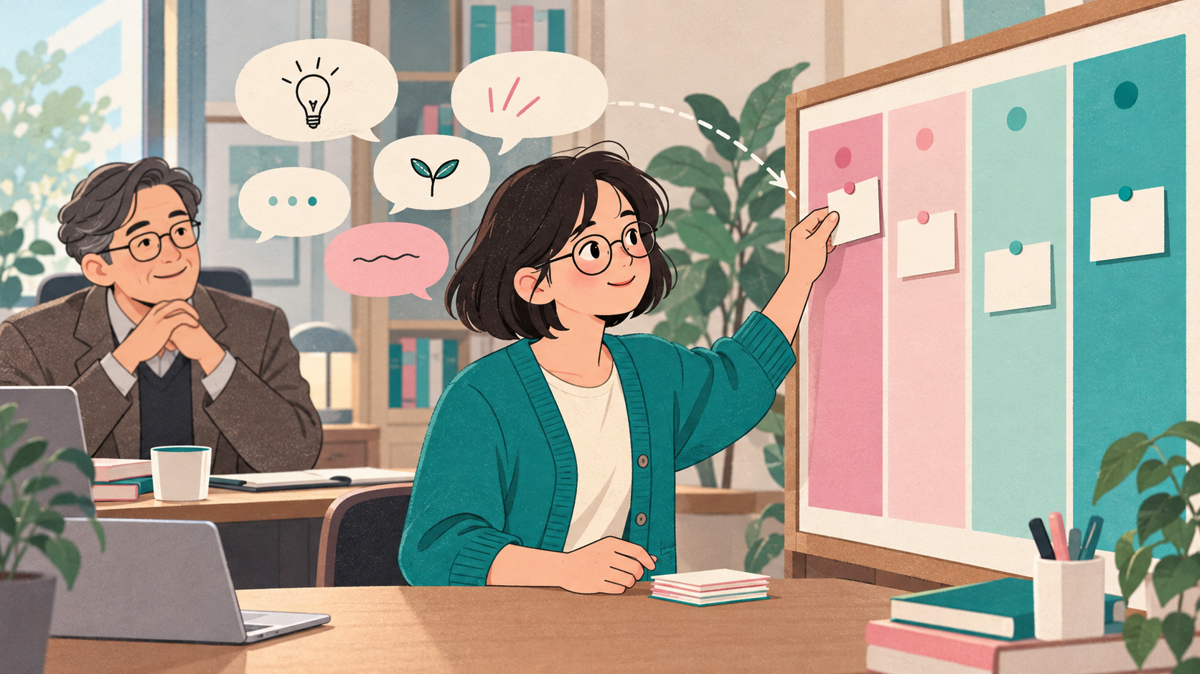
Fictional example · AI-generated illustration
“Redo it.” What do you do after that?
- Hearing “The topic is broad,” “Research already exists,” “Distinguish the concepts,” or “Read more” may leave you feeling bad.
- If your only note is “Redo it,” you may ask GPT for topics from scratch the next day. What you checked this time does not connect to the next task.
- Separate what the professor actually said from what you understood it to mean. Record it in a form you can check if you misunderstood.
Separate the professor's words, your interpretation, and the next action
| Category | Minseo's fictional meeting record |
|---|---|
| What I heard | “Distinguish accuracy judgments from trust.” Record the actual feedback first. |
| My interpretation | “I understood this as a request to compare the measurement items for the two concepts.” Do not assume in advance that your interpretation matches the professor's words. |
| A question to confirm | “Should I compare how the two concepts were measured in the papers and bring that?” If uncertain, confirm briefly through the preferred communication channel. |
Write a reading task with a visible endpoint
01
Choose where to read
Find the section showing how trust was measured in the recommended paper. If you have not located it, begin by recording that search task.
02
Choose what to compare
Compare those items with the accuracy items in the first paper. Try to explain whether they ask the same thing or different things.
03
Record how your wording changed
“Initially I thought in terms of believing less, but after the meeting I decided to distinguish accuracy from trust.” Record why the question changed.
04
Bring it to the next conversation
Give both AI and your instructor the previous feedback and your latest checks. Do not restart every new chat by asking for research titles.
If you understood, where is your own sentence?
Your field of interest can be different
- It need not be AI and news. Describe your current interest in your own words, whether counseling, education, health information, religion, or political communication.
- If you wrote only “affects,” restate both sides in terms of human behavior. Who sees what, and what might they do differently?
Finding one confusion is progress too
- If you wrote “The effect of short-form video on consumption,” discovering that you have not distinguished purchasing from recommending changes your next question.
- Generate search terms, open one actual source, and find what people were shown or asked. Read that paragraph and see whether your question needs different wording.
Today, show the current state of your work
| Current state | What you can show | The next help to seek |
|---|---|---|
| I could not find a source | Show the search terms you used and the search results where you got stuck. | Examine together whether the scope is too broad or another field's vocabulary is needed. |
| I got stuck while reading | Record the source, the location you checked, and the sentence you could not explain. | Ask which concepts to distinguish and where to read further. |
| I only have an AI explanation | Mark that you have not yet checked it in the original. | Begin by locating where the explanation can be compared with actual evidence. |
Show where you read and where you got stuck
“I have checked this far”
- Attach the link and location of the paper you actually read to “this far.” Show what you read and how your wording changed.
- Your initial interest may remain the same. Show what you want to check next.
“I find this part difficult to judge”
- Attach the question you cannot decide alone to “this part.” It gives us material for deciding together what to check next.
- An instructor can help from the point where your understanding ends. Do not wait until this sentence is perfect; bring the blanks as they are now.
Continue after class through questions
Advisor finds actual papers, narrows what to read, and records what you explained and what you still do not know. It does not fill your knowledge record with explanations AI supplied.
Download the skill ZIP and empty student Obsidian vault, and follow the starting guide. Bring an initial interest sentence, a paragraph where reading stalled, or advisor feedback—not a completed proposal.
Download the skill ZIP Download the empty student vault
Start the first conversation with this sentence
What I want to understand is ○○.
“This is what I have checked so far, and this part I cannot explain. Please ask me questions and help me find what I need to read myself.”
If you do not know an answer, say so. Narrow the reading, then continue the record with sentences you can explain after reading. Today's lecture provides a starting point for that conversation.