## Read the complete lecture
Even in an age when AI does the analysis for us, researchers must decide what to test. Starting from the basic structure of a hypothesis and H1·H0, and from the level of measurement of variables, we ask again why your hypothesis can become scientific knowledge.
The Week 9 lecture for the graduate course Communication Research Methods II at Hallym University Media School. It was rebuilt with Achmage Presentation, keeping the wording and order of the Week 9 materials from the 2024 undergraduate research methods course unchanged. It covers falsifiability · comprehensiveness · replicability, deduction and induction, Type I · Type II errors in inferential statistics, and the steps for generalizing a hypothesis through related studies and theory.
The concept diagrams were drawn with Achmage Pele, and the photos and illustrations are originals from the 2024 lecture materials (original sources not stated). The weekly assignment on the last slide has three items in which you formulate a hypothesis · research question from your own research interests and look for survey scales.
Includes the Korean slides and full reading version, with English introduction and reading.
## 01\. 9W-1
Communication Research Methods II (Fall 2026)
### Supporting text from the original screen
01 / 42
9W-1 · 1/1
## 02\. How do you make a “hypothesis”?
**Do not make hypotheses like these:**
* If A increases and then decreases, B decreases and then increases
* Since A does not increase and then suddenly increases, B decreases and then suddenly stops
* As A increases up to a certain point and then decreases again, B will increase up to a certain point and then increase again
**Just remember the following cases (the basic structure of a hypothesis):**
* The more A increases, the more B increases (A↑ → B↑)
* In other words, A and B have a (+) relationship (A →(+) B)
* A increases but B decreases (A↑ → B↓)
* In other words, A decreases but B increases (A↓ → B↑)
* To put it yet another way, A and B have a (-) relationship (A →(-) B)
### Supporting text from the original screen
02 / 42
Hypothesis-setting review · 1/3
## 03\. Summary of the whole process of setting and testing a “hypothesis”
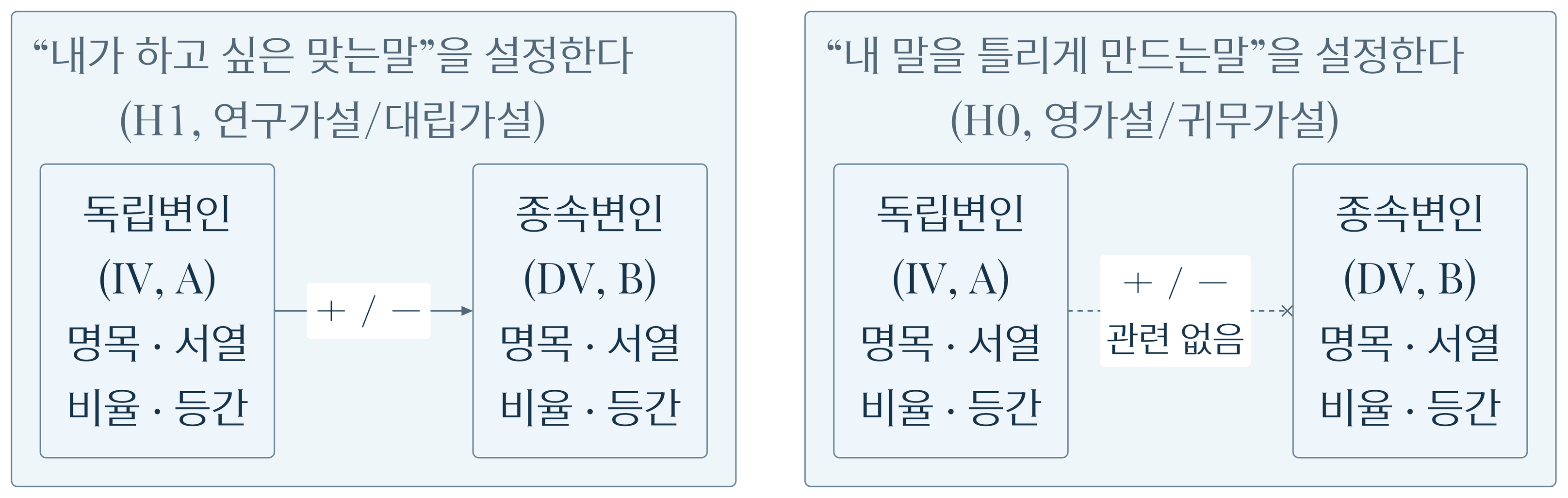
The left box is H1 (research hypothesis/alternative hypothesis), which sets up “the right thing I want to say”: there is a + or − relationship between the independent variable (IV, A) and the dependent variable (DV, B). The right box is H0 (null hypothesis), which sets up “the statement that makes what I say wrong”: there is no + or − relationship between the same two variables (unrelated). Both variables are measured at one of these levels: nominal · ordinal · ratio · interval.
### Supporting text from the original screen
03 / 42
Hypothesis-setting review · 2/3
## 04\. Example – “Women's average Netflix drama viewing time is longer than men's”
Gender: when coded as male: 0, female: 1
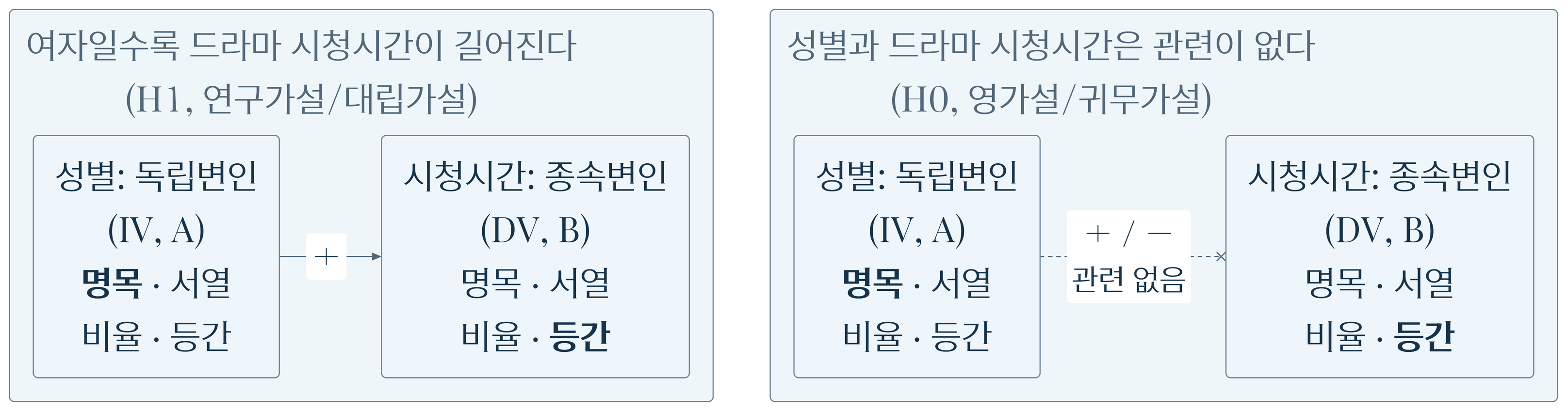
A hypothesis about gender (independent variable, coded male 0 · female 1) and drama viewing time (dependent variable). The levels of measurement are shown in bold: nominal for gender and interval for viewing time. The left box, H1 (research hypothesis/alternative hypothesis), is a + relationship in which drama viewing time is longer for women; the right box, H0 (null hypothesis), states that gender and drama viewing time are unrelated.
### Supporting text from the original screen
04 / 42
Hypothesis-setting review · 3/3
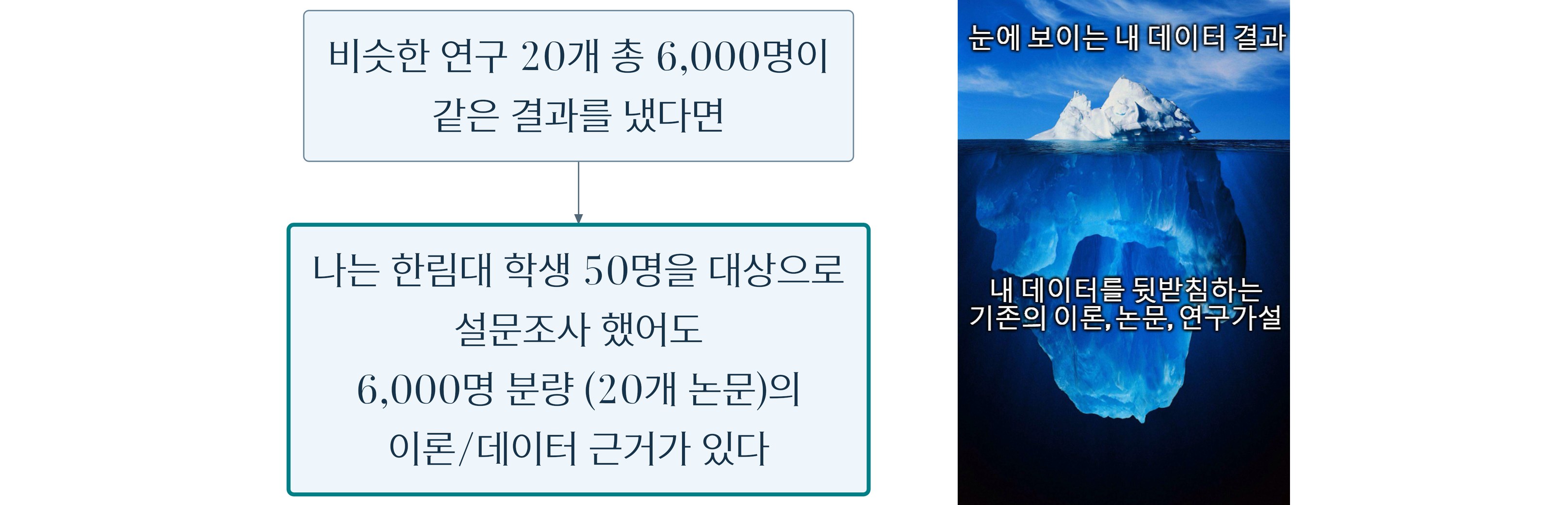
## 05\. Methodological foundations: methods of acquiring scientific knowledge
### Supporting text from the original screen
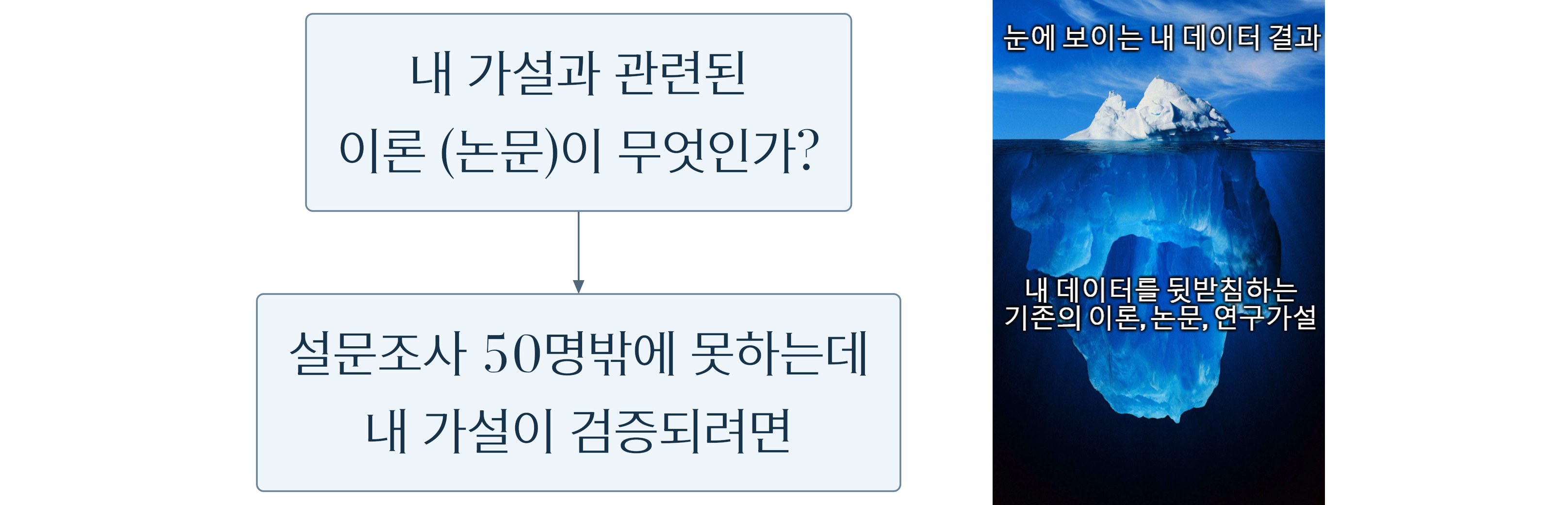
05 / 42
Methods of acquiring scientific knowledge · 1/8
## 06\. Social-science communication: the convergence of the humanities and science
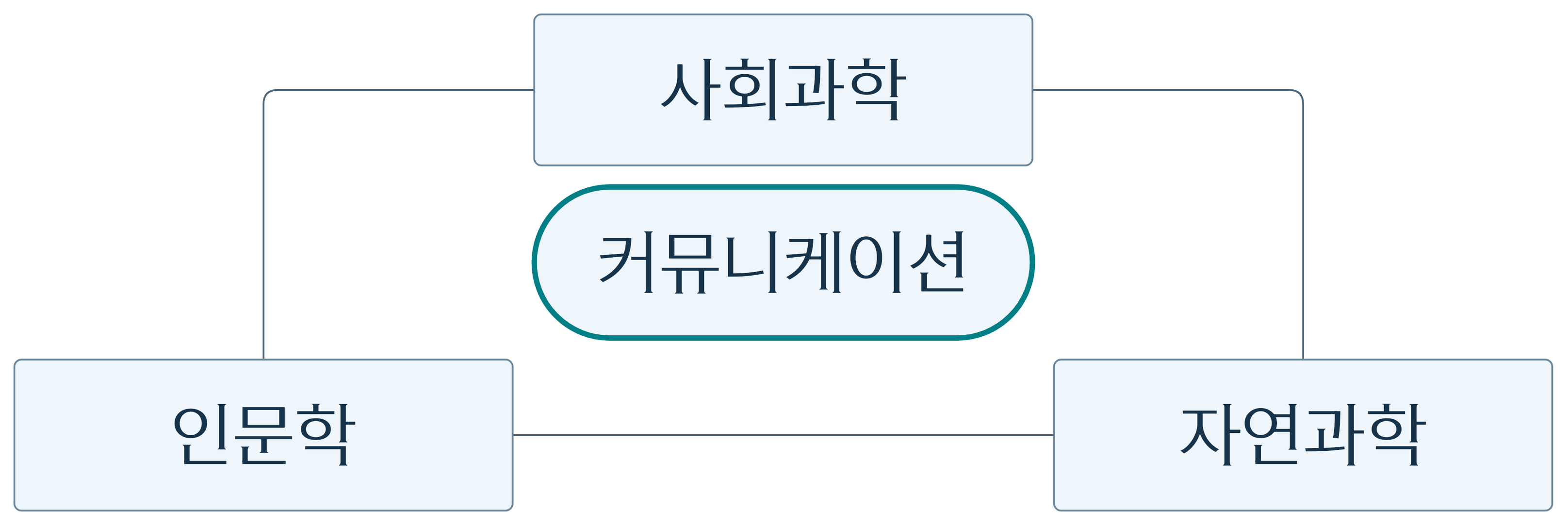
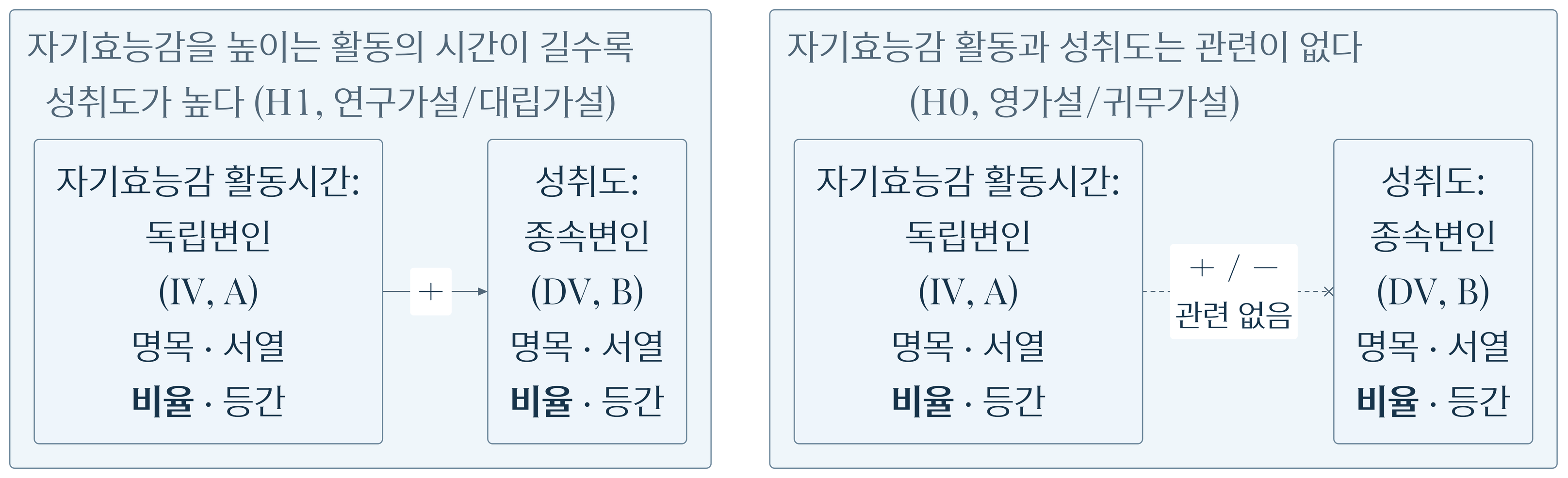
Communication sits at the center of a triangle whose vertices are social science (top), the humanities (bottom left), and natural science (bottom right).
### Supporting text from the original screen
06 / 42
Methods of acquiring scientific knowledge · 2/8
## 07\. The science of communication
* Part of a larger family of sciences known as the social sciences
* Its purpose is mainly to study human behavior, dispositions, attitudes, habits, and so on
* Simply put, it studies psychological processes and the behavior that results from them
* A combination of psychology and the field of communication

### Supporting text from the original screen
07 / 42
Methods of acquiring scientific knowledge · 3/8
## 08\. Benefits of communication research
Goals of social-science communication research:
* Description of communication behavior (Describe communication behavior)
* Identification of the causes of communication behavior (Determine causes of communication behavior)
* Prediction of future communication behavior (Predict future communication behavior)
* Explanation of communication behavior (Explain communication behavior)
* Control of communication outcomes (Control communication outcomes)

### Supporting text from the original screen
08 / 42
Methods of acquiring scientific knowledge · 4/8
## 09\. Benefits of communication research
Examples:
**Description of human communication behavior:**
“My friend's expression looks really bad today”
**Identification of the causes of human communication behavior:**
“Because they use Insta 10 hours a day and their phone broke”
**Prediction of human communication behavior:**
“The more a person uses social media on their smartphone, the greater their psychological dependence on social media will be”
**Explanation of human communication behavior:**
“The fact that psychological dependence grows as smartphone social media use increases can be explained by smartphone addiction theory”
**Control of human communication outcomes:**
“According to smartphone addiction theory, the higher a person's self-esteem, the lower their smartphone addiction”
### Supporting text from the original screen
09 / 42
Methods of acquiring scientific knowledge · 5/8
## 10\. The problem with common sense – “Did you really double-check that claim?”
**Common sense is like air freshener. The people who need it most never use it.**

### Supporting text from the original screen
10 / 42
Methods of acquiring scientific knowledge · 6/8
## 11\. The problem with common sense – “Did you really double-check that claim?”
**“The world is unfair”**
Did you actually bother to check once more whether it is really unfair?

### Supporting text from the original screen
11 / 42
Methods of acquiring scientific knowledge · 7/8
## 12\. The problem with common sense and critical thinking
What comes to mind when you watch the following advertisement? (Samsung Ballie advertisement)
[https://www.youtube.com/watch?v=YBfSX3QiqDM](https://www.youtube.com/watch?v=YBfSX3QiqDM)
**Is it plausible? Is it useful? Does it make sense?**

### Supporting text from the original screen
12 / 42
Methods of acquiring scientific knowledge · 8/8
## 13\. Methodological foundations: conditions of scientific knowledge
### Supporting text from the original screen
13 / 42
Conditions of scientific knowledge · 1/8
## 14\. Condition 1 of scientific knowledge: “Falsifiability”
Scientific common knowledge must have a chance of being wrong, even if only 0.001%
“IU is an alien. Yesterday I clearly saw her get off a UFO, and I was the only one who saw it”
“Among Hallym University students, female students take more AI-related hands-on courses than male students”
> Which of the two sentences is falsifiable?
### Supporting text from the original screen
14 / 42
Conditions of scientific knowledge · 2/8
## 15\. Condition 1 of scientific knowledge: “Falsifiability”
Scientific common knowledge must have a chance of being wrong, even if only 0.001%
“God exists. This is because it is written so in the Bible”
“Light is a wave and, at the same time, also a particle”
> Which of the two sentences is falsifiable?
### Supporting text from the original screen
15 / 42
Conditions of scientific knowledge · 3/8
## 16\. Condition 2 of scientific knowledge: “Comprehensiveness”
A scientific knowledge proposition must be both specific and comprehensive.
“Among students, female students take more AI-related hands-on courses than male students”
> Which students? Hallym University students? Kangwon National University? High school students? University students? Which courses count as “AI hands-on courses”?
### Supporting text from the original screen
16 / 42
Conditions of scientific knowledge · 4/8
## 17\. Premise 4 of inferential statistics: we cannot pin down the population exactly, but we want to pin it down as accurately as possible
Premise 4: We cannot know it exactly, but we want to take a stab at it “as accurately as possible”
If you narrow the range too precisely, “the chance that what I say is wrong” goes up (Type I error)
If you widen the range too much, “what I say becomes empty talk” (Type II error)
**“How can what I say avoid being wrong and still have substance?”**
Whether it avoids being wrong: significance test (conventionally at the p < .05 level)
How much substance the claim has: statistical power test (Effect Size)
### Supporting text from the original screen
17 / 42
Conditions of scientific knowledge · 5/8
## 18\. Statistical estimation range: being “right” is not what matters
What if you narrow the range sharply?
* “The cats in our neighborhood weigh between 49kg and 50kg on average.”
* “The average wait time at this restaurant is from 1 minute to 1 minute 30 seconds.”
* “The average temperature in our city today is between minus 10 and minus 10.3 degrees.”
* “There are 1,353,745 books in the school library.”
* “This smartphone's battery life is estimated at 23.4 hours.”
> The chance that my claim is wrong goes up = the statistical “p-value (significance)” drops. In other words, a Type I error occurs
### Supporting text from the original screen
18 / 42
Conditions of scientific knowledge · 6/8
## 19\. Statistical estimation range: being “right” is not what matters
…If you do statistics like this, who would be bad at statistics?
* “The cats in our neighborhood weigh between 1kg and 50kg on average.”
* “The average wait time at this restaurant is from 1 minute to all day.”
* “The average temperature in our city today will be between minus 20 and plus 50 degrees.”
* “The school library has at least 100 to 1 million books.”
* “This smartphone's battery life is estimated to be between 1 hour and 1 year.”
> The “density (or persuasiveness)” of my claim drops = the statistical “Power” drops. In other words, a Type II error occurs
### Supporting text from the original screen
19 / 42
Conditions of scientific knowledge · 7/8
## 20\. Condition 3 of scientific knowledge: “Replicability”
A scientific knowledge proposition must be something others can replicate too.
“I wrote a paper, and I made up its data with ChatGPT. But even if I type in the exact same prompt, it does not come out the same as what I did. Anyway, it just made it for me on its own, you know?”
> …Not only does this lack replicability, it is also highly unethical.
### Supporting text from the original screen
20 / 42
Conditions of scientific knowledge · 8/8
## 21\. Methodological foundations: methods of acquiring scientific knowledge
### Supporting text from the original screen
21 / 42
Methods of acquiring scientific knowledge · 1/4
## 22\. Methods of acquiring scientific knowledge
**Rational knowledge: deduction**
A method of deriving knowledge based on logic and reasoning
* All humans die someday
* And I am a human
* Therefore, I will die someday
**Empiricism: induction**
A method of reasoning backward from data to a general proposition
* I collected data on human lifespans for 2,000 years
* It turned out that in every country and every era, the average lifespan had never exceeded 150 years
* Therefore, the human lifespan cannot exceed 150 years
* Therefore, humans die someday
### Supporting text from the original screen
22 / 42
Methods of acquiring scientific knowledge · 2/4
## 23\. Methods of acquiring scientific knowledge

The arrow going down from the general proposition “All humans die” at the top to the data statement at the bottom is deduction (logic and reasoning). The arrow going up from the data statement “When all lifespan data in human history were collected, the average human lifespan had never once exceeded 150 years” at the bottom to the general proposition at the top is induction (data).
### Supporting text from the original screen
23 / 42
Methods of acquiring scientific knowledge · 3/4
## 24\. Methods of acquiring scientific knowledge
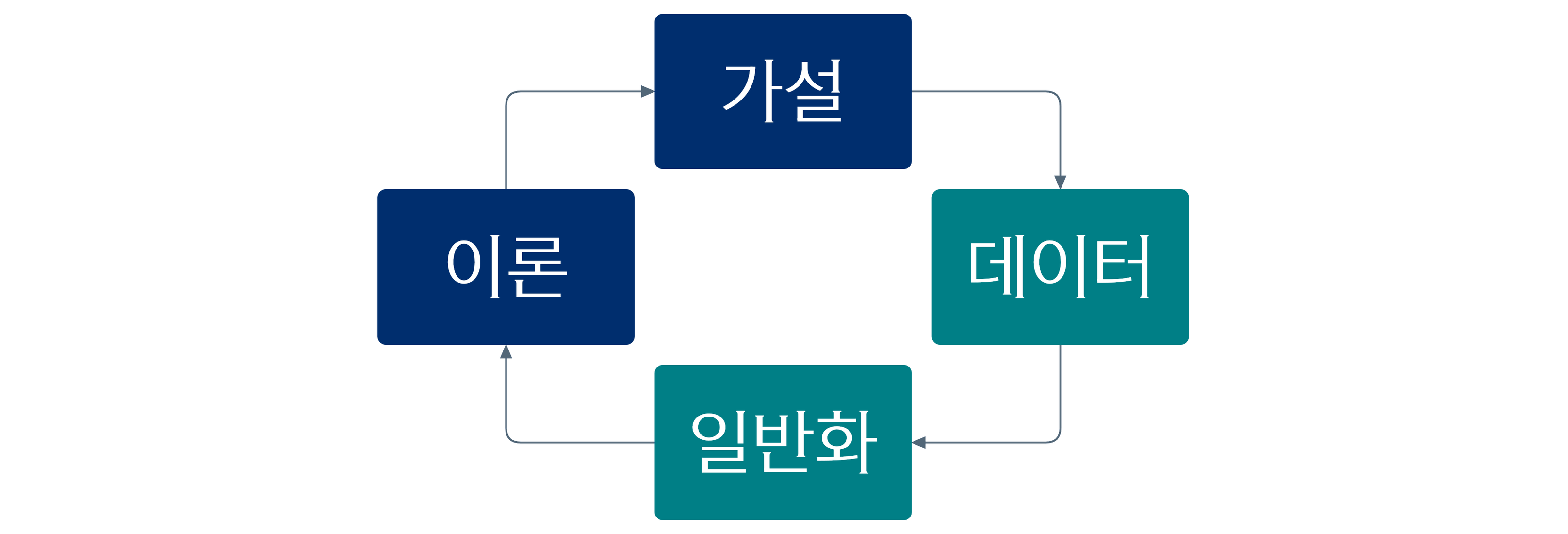
Four concepts are arranged in a diamond and cycle through clockwise arrows that run around the outer corners. The arrows lead from theory on the left to hypothesis at the top, from hypothesis to data on the right, from data to generalization at the bottom, and from generalization back to theory. Hypothesis and theory are grouped in the same color (the logic and reasoning side), and data and generalization in another shared color (the data side).
### Supporting text from the original screen
24 / 42
Methods of acquiring scientific knowledge · 4/4
## 25\. Why is theory important?
### Supporting text from the original screen
25 / 42
Why is theory important? · 1/17
## 26\. Let us grab some candy with our fists.
**Population**
Candy box – the entire population of Korea
**Shall we grab just a few?**
Sample 1 – survey of 1,000 people
**OR · Shall we grab a fistful so full it bursts?**
Sample 2 – survey of 100,000 people

Photos, from left: a box full of candy (population), a fist and only a few candies (Sample 1), and a fist and a big pile of bubble gum (Sample 2)
### Supporting text from the original screen
26 / 42
Why is theory important? · 2/17
## 27\. Summary of the basics of inferential statistics
* It is impossible to know perfectly a specific parameter of the population (e.g., the total number of strawberry chocolates in the box)
* Searching through the entire population (inside the box) is a brute-force and inefficient method
* I count only the candies in my palm, then “estimate” the original box from the “pattern” of the candies in my palm
* We cannot know the perfect answer because we “estimate” (we guess using probability)
* “(Since I cannot guess the population perfectly) how wrong I am” = the standard error.

**Population**

**I want to know how many “just strawberry chocolates” are in the box**
Surely you are not going to tear open this whole box and count them one by one?
### Supporting text from the original screen
27 / 42
Why is theory important? · 3/17
## 28\. Examples of hypotheses
01 “How might Hallym University students' academic achievement be related to their self-esteem?”
02 “What effect do student club activities within Hallym University have on university students' employment success rate?”
03 “What might be the effect of social media use on the social relationships of Hallym University students?”
04 “What is the effect of university students' housing type on their academic achievement?”
05 “What effect does the stress level of Hallym University students have on their academic performance?”
06 “What effect might university students' income level have on their academic engagement?”
07 “What is the effect of university students' amount of exercise on their academic performance?”
08 “Do Hallym University students' eating habits and sleep time affect their grades?”
09 “What is the effect of university students' family relationships on their university life?”
10 “What effect does Hallym University students' motivation to get a job have on their academic performance?”
### Supporting text from the original screen
28 / 42
Why is theory important? · 4/17
## 29\. Examples of hypotheses
> “What effect do student club activities within Hallym University have on university students' employment success rate?”
…If you were told to start a survey tomorrow, right away, to test this hypothesis, what would you do?
### Supporting text from the original screen
29 / 42
Why is theory important? · 5/17
## 30\. Examples of hypotheses
**“What effect do student club activities within Hallym University have on university students' employment success rate?”**
“Sorry, but before you go into the CLC cafeteria, please fill out just this one survey sheet here”
**…Surely you are not going to stop people one by one and ask them?**

### Supporting text from the original screen
30 / 42
Why is theory important? · 6/17
## 31\. RQ. How many strawberry chocolate candies are there in total among all the original candies?

**Population**
An imaginary candy box holding many kinds of candy, as many as the population of Korea (e.g., 50 million)
We do not know how many kinds of candy there are

**I want to know how many “just strawberry chocolates” are in the box**
Surely you are not going to tear open this whole box and count them one by one?
### Supporting text from the original screen
31 / 42
Why is theory important? · 7/17
## 32\. Why is theory important?
**⊘ “What effect do (student club) activities within Hallym University have on university students' (employment) success rate?”**
**Step 1. Keep only the core of the variables, turn it into a generalized proposition, and look for related studies:**
Studies on the club activities of just “students” and the employment rates of “students”
Include studies of high school students, not just university students
Even if it is not necessarily a club –studies on Cheerleading team activities and grades
### Supporting text from the original screen
32 / 42
Why is theory important? · 8/17
## 33\. Why is theory important?
**Step 2. Check whether the studies you found all use the same theory:**
Studies on the club activities of just “students” and the employment rates of “students”
Include studies of high school students, not just university students
Even if it is not necessarily a club –studies on Cheerleading team activities and grades
> Turns out the studies above all use a theory of “self-efficacy” – if studies with similar content share the same theory, we basically regard them as research with the same content as my hypothesis
### Supporting text from the original screen
33 / 42
Why is theory important? · 9/17
## 34\. Why is theory important?
**Step 3. Check the direction of the statistical results (significance, effect size):**
Studies on the club activities of just “students” and the employment rates of “students”
Include studies of high school students, not just university students
Even if it is not necessarily a club –studies on Cheerleading team activities and grades
* Turns out the studies above all use a theory of “self-efficacy”
* Turns out there are 20 such studies, and each surveyed 300 people
* All 20 studies found that students' activities have a significant positive (+) effect on grades/employment rates/start-up rates/achievement/satisfaction, etc.
### Supporting text from the original screen
34 / 42
Why is theory important? · 10/17
## 35\. Why is theory important?
**“What effect do (student club) activities within Hallym University have on university students' (employment) success rate?”**
* Studies on the club activities of just “students” and the employment rates of “students”
* Include studies of high school students, not just university students
* Even if it is not necessarily a club –studies on Cheerleading team activities and grades
* Turns out the studies above all use a theory of “self-efficacy”
* Turns out there are 20 such studies, and each surveyed 300 people
* All 20 studies found that students' activities have a significant positive (+) effect on grades/employment rates/start-up rates/achievement/satisfaction, etc.

If 20 similar studies with a total of 6,000 people produced the same results, then even if I surveyed 50 Hallym University students, I have theory/data grounds worth 6,000 people (20 papers).
### Supporting text from the original screen
35 / 42
Why is theory important? · 11/17
## 36\. Why is theory important?
**“What effect do (student club) activities within Hallym University have on university students' (employment) success rate?”**
If 20 similar studies with a total of 6,000 people produced the same results, then even if I surveyed 50 Hallym University students, I have theory/data grounds worth 6,000 people (20 papers). On the right is an iceberg image: the small part above the water is labeled 'My visible data results' and the large part below the water is labeled 'Existing theories, papers, and research hypotheses that support my data'.
My visible data results · Existing theories, papers, and research hypotheses that support my data
### Supporting text from the original screen
36 / 42
Why is theory important? · 12/17
## 37\. Why is theory important?
**“What effect do (student club) activities within Hallym University have on university students' (employment) success rate?”**
An arrow leads from “What is the theory (paper) related to my hypothesis?” at the top to “For my hypothesis to be tested when I can survey only 50 people” at the bottom. On the right is an iceberg image: the small part above the water is labeled 'My visible data results' and the large part below the water is labeled 'Existing theories, papers, and research hypotheses that support my data'.
My visible data results · Existing theories, papers, and research hypotheses that support my data
### Supporting text from the original screen
37 / 42
Why is theory important? · 13/17
## 38\. Why is theory important?
**Step 4. Write a sentence that turns my original hypothesis into a generalized, comprehensive proposition**

In the top box, “What is the theory (paper) related to my hypothesis?” leads to “For my hypothesis to be tested when I can survey only 50 people”. Below that, the original research question “What effect do (student club) activities within Hallym University have on university students' (employment) success rate?” changes into the generalized research question “What effect do activities that raise university students' self-efficacy have on achievement?”
### Supporting text from the original screen
38 / 42
Why is theory important? · 14/17
## 39\. Summary of the whole process of setting and testing a “hypothesis”

The left box is H1 (research hypothesis/alternative hypothesis), which sets up “the right thing I want to say”: there is a + or − relationship between the independent variable (IV, A) and the dependent variable (DV, B). The right box is H0 (null hypothesis), which sets up “the statement that makes what I say wrong”: there is no + or − relationship between the same two variables (unrelated). Both variables are measured at one of these levels: nominal · ordinal · ratio · interval.
### Supporting text from the original screen
39 / 42
Why is theory important? · 15/17
## 40\. “What effect do activities that raise university students' self-efficacy have on achievement?”
**Step 5: Check how each independent variable and dependent variable was measured in the 20 studies I found**
A hypothesis about self-efficacy activity time (independent variable) and achievement (dependent variable). For both variables, ratio is shown in bold as the level of measurement. The left box, H1 (research hypothesis/alternative hypothesis), is a + relationship: the longer the time spent on activities that raise self-efficacy, the higher the achievement. The right box, H0 (null hypothesis), states that self-efficacy activities and achievement are unrelated.
### Supporting text from the original screen
40 / 42
Why is theory important? · 16/17
## 41\. Examples of hypotheses you can use in a research proposal
01 “How might Hallym University students' academic achievement be related to their self-esteem?”
02 “What effect do student club activities within Hallym University have on university students' employment success rate?”
03 “What might be the effect of social media use on the social relationships of Hallym University students?”
04 “What is the effect of university students' housing type on their academic achievement?”
05 “What effect does the stress level of Hallym University students have on their academic performance?”
06 “What effect might university students' income level have on their academic engagement?”
07 “What is the effect of university students' amount of exercise on their academic performance?”
08 “Do Hallym University students' eating habits and sleep time affect their grades?”
09 “What is the effect of university students' family relationships on their university life?”
10 “What effect does Hallym University students' motivation to get a job have on their academic performance?”
### Supporting text from the original screen
41 / 42
Why is theory important? · 17/17
## 42\. This week's assignment
**01 Create a hypothesis/research question**
Create a hypothesis/research question that fits your own research interests and bring it with you
**02 Turn it into the basic structure of a hypothesis**
Think about how you would turn that hypothesis/research question into the ‘basic structure of a hypothesis’ (H1·H0, A↑ → B↑ / A↑ → B↓)
**03 Find · make a survey scale**
Find or make survey scales to measure the independent variable · dependent variable (if you found one, source: paper citation + page)
### Supporting text from the original screen
42 / 42
This week's assignment · 1/1