If AI does it all, why should we formulate research hypotheses? — Foundations of quantitative research methods in the social sciences
Why should you formulate research hypotheses yourself when AI can even do the analysis for you? A 42-slide lecture that moves from the basic structure of a hypothesis to the conditions of scientific knowledge, deduction and induction, and the role of theory.
Graduate students who run analyses with AI but still struggle to explain why and how to formulate research hypotheses · Hallym University Media School, graduate program · Communication Research Methods II · November 3, 2026 · 2026.11.03
What this project covers
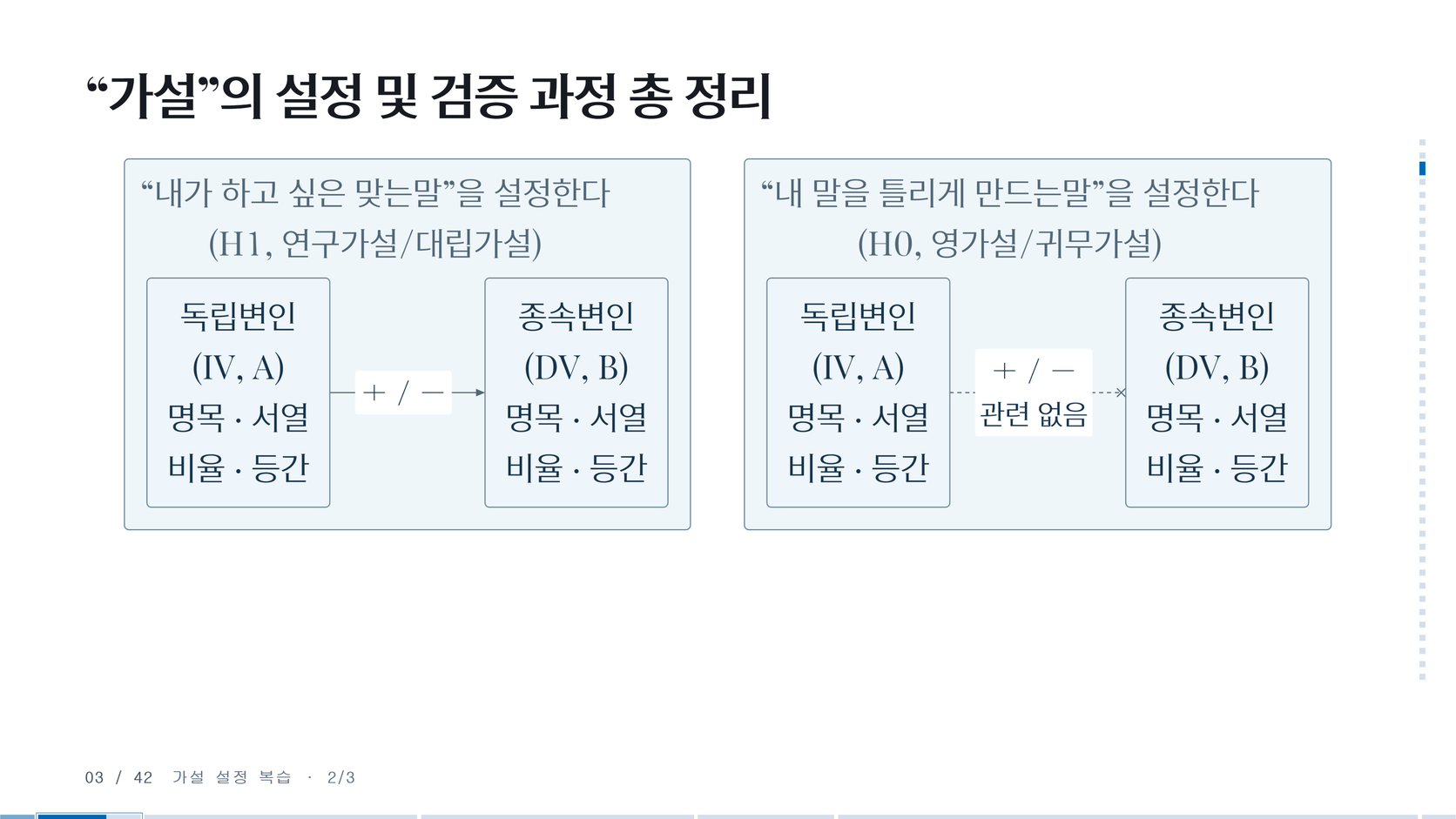
- Write a hypothesis in the basic structure ‘if A increases, B also increases or decreases’ and as H1·H0.
- Check the conditions of scientific knowledge through falsifiability · comprehensiveness · replicability.
- Generalize your hypothesis through related studies and theory, and check the level of measurement of the variables.
Presentation outline
Expand the full outline
- Read the complete lecture
- 01. 9W-1
- Supporting text from the original screen
- 02. How do you make a “hypothesis”?
- Supporting text from the original screen
- 03. Summary of the whole process of setting and testing a “hypothesis”
- Supporting text from the original screen
- 04. Example – “Women's average Netflix drama viewing time is longer than men's”
- Supporting text from the original screen
- 05. Methodological foundations: methods of acquiring scientific knowledge
- Supporting text from the original screen
- 06. Social-science communication: the convergence of the humanities and science
- Supporting text from the original screen
- 07. The science of communication
- Supporting text from the original screen
- 08. Benefits of communication research
- Supporting text from the original screen
- 09. Benefits of communication research
- Supporting text from the original screen
- 10. The problem with common sense – “Did you really double-check that claim?”
- Supporting text from the original screen
- 11. The problem with common sense – “Did you really double-check that claim?”
- Supporting text from the original screen
- 12. The problem with common sense and critical thinking
- Supporting text from the original screen
- 13. Methodological foundations: conditions of scientific knowledge
- Supporting text from the original screen
- 14. Condition 1 of scientific knowledge: “Falsifiability”
- Supporting text from the original screen
- 15. Condition 1 of scientific knowledge: “Falsifiability”
- Supporting text from the original screen
- 16. Condition 2 of scientific knowledge: “Comprehensiveness”
- Supporting text from the original screen
- 17. Premise 4 of inferential statistics: we cannot pin down the population exactly, but we want to pin it down as accurately as possible
- Supporting text from the original screen
- 18. Statistical estimation range: being “right” is not what matters
- Supporting text from the original screen
- 19. Statistical estimation range: being “right” is not what matters
- Supporting text from the original screen
- 20. Condition 3 of scientific knowledge: “Replicability”
- Supporting text from the original screen
- 21. Methodological foundations: methods of acquiring scientific knowledge
- Supporting text from the original screen
- 22. Methods of acquiring scientific knowledge
- Supporting text from the original screen
- 23. Methods of acquiring scientific knowledge
- Supporting text from the original screen
- 24. Methods of acquiring scientific knowledge
- Supporting text from the original screen
- 25. Why is theory important?
- Supporting text from the original screen
- 26. Let us grab some candy with our fists.
- Supporting text from the original screen
- 27. Summary of the basics of inferential statistics
- Supporting text from the original screen
- 28. Examples of hypotheses
- Supporting text from the original screen
- 29. Examples of hypotheses
- Supporting text from the original screen
- 30. Examples of hypotheses
- Supporting text from the original screen
- 31. RQ. How many strawberry chocolate candies are there in total among all the original candies?
- Supporting text from the original screen
- 32. Why is theory important?
- Supporting text from the original screen
- 33. Why is theory important?
- Supporting text from the original screen
- 34. Why is theory important?
- Supporting text from the original screen
- 35. Why is theory important?
- Supporting text from the original screen
- 36. Why is theory important?
- Supporting text from the original screen
- 37. Why is theory important?
- Supporting text from the original screen
- 38. Why is theory important?
- Supporting text from the original screen
- 39. Summary of the whole process of setting and testing a “hypothesis”
- Supporting text from the original screen
- 40. “What effect do activities that raise university students' self-efficacy have on achievement?”
- Supporting text from the original screen
- 41. Examples of hypotheses you can use in a research proposal
- Supporting text from the original screen
- 42. This week's assignment
- Supporting text from the original screen
Resources
- Lecture slides · 42 slides in Korean ↗ HTML · 1.0.0